
TL;DR
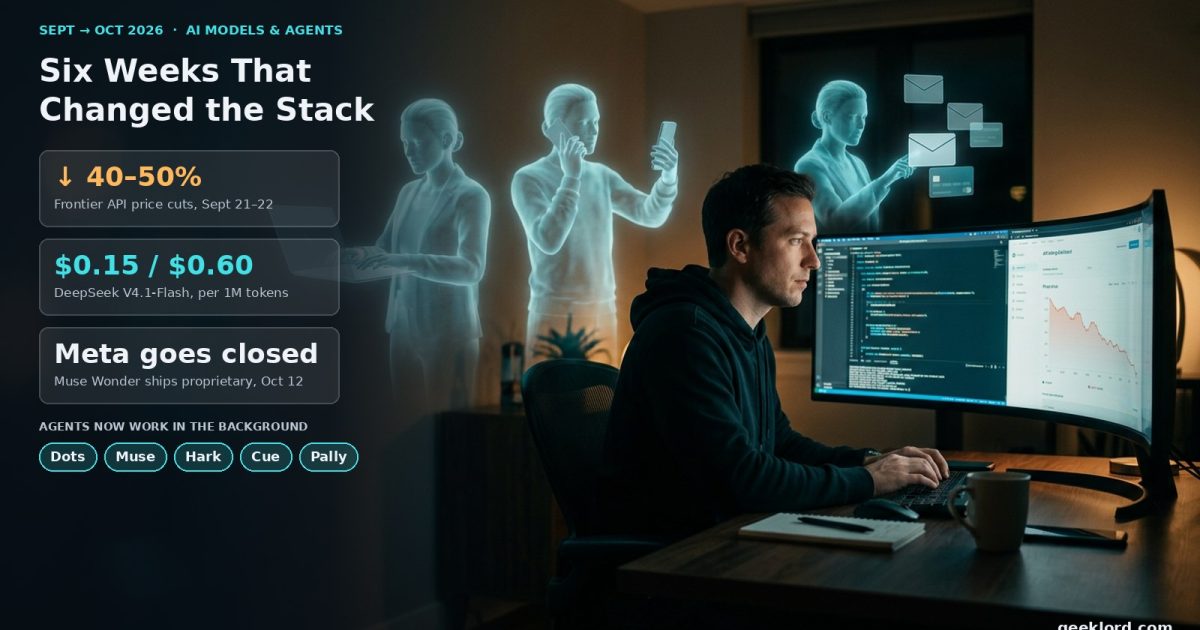
- Prices fell hard. Between September 21 and 22, OpenAI, Anthropic and xAI cut frontier pricing by 40% to 50%, ten days after DeepSeek V4.1-Flash landed at $0.15 / $0.60 per 1M tokens.
- Meta went closed. Muse Wonder and Wonder Full (October 12) are proprietary and sold through the Meta Model API, a sharp turn from the Llama playbook.
- Agents left the chat tab. Dots, Muse, Hark, Cue and Pally now run in the background with their own computers, phone numbers, inboxes and wallets.
- Your bot filters probably can’t see them. VM-hosted agents present as ordinary Chrome sessions, so site owners need to audit firewall and CAPTCHA rules now.
On October 7, security firm Cequence Security published a telemetry report that made me stop and audit the bot filters on three client web apps we maintain at Cyber Mitra Solutions. Within fourteen days of Meta launching its personal AI agent Muse on September 8, traffic matching Muse showed up at more than half of the enterprise networks Cequence monitored. Almost none of those companies knew it was there. Because each Muse instance spins up inside a cloud virtual machine and presents a standard Chrome browser fingerprint without an agent header, normal web application firewalls wave it right through as a human visitor.
For the last three years, integrating AI meant wiring up a request-response loop: a user types a prompt, an API streams tokens back, and the session goes cold until the next click. Between September 1 and October 12, 2026, that assumption broke in two places at once.
First, the frontier model labs (Anthropic, OpenAI, Google, Meta, xAI, and DeepSeek) shipped a dense wave of model updates while slashing inference prices by 40% to 50% in a single week. Second, the product layer moved out of the chat tab and into persistent background agents (Dots, Muse, Hark, Cue, and Pally) that hold their own cloud computers, phone numbers, email addresses, and payment cards.
Here is my breakdown of what actually shipped over the past six weeks, where the marketing benchmarks hide real failures, and how I am routing production workloads right now.
Part 1: The September to October 2026 Model Wave
If you haven’t checked your API billing dashboard since August, your default model routes are probably overpriced. The defining move of late September and early October wasn’t a single benchmark leap; it was a brutal price-performance compression triggered on September 22, followed by Meta abandoning its open-weights-only posture on October 12.
| Provider | Model Releases (Sept to Oct 2026) | Key Specs & Pricing Context | Where It Fits |
|---|---|---|---|
| Meta | Muse Wonder & Muse Wonder Full (Oct 12) Muse Spark 1.3 / 1.3 Max (Sept 2 to 5) | Proprietary frontier release; ties Claude at 56 on the Artificial Analysis Intelligence Index. Includes Active Memory and Active Focus. | Enterprise agent loops via Meta Model API; paid subscribers on Muse Code and the Muse app. |
| Gemini 4 Argon (Sept 30) Gemini 3.8 Flash & 3.8 Flash Cyber (Sept 2) | Next-gen frontier reasoning and multimodal stack following May’s Gemini 3.5 Flash ($1.50 / $9.00 per 1M tokens). | High-throughput coding, security analysis, and native multimodal orchestration. | |
| OpenAI | GPT-6.1 Sol (Sept 29) GPT-6 Sol & GPT-6 Luna (Sept 22) GPT-6 Astra (Sept 3) | Sol and Luna cut token costs 50% below prior tiers. Astra powers OpenAI’s Dots agents (while GPT-6.1 Astra was paused over safety checks). | Astra for strict instruction-following in background agents; Sol / Luna for cost-capped production APIs. |
| Anthropic | Claude Sonnet 5.5 (Sept 28) Claude Opus 5.5 (Sept 22) Claude Fable 5.1 & Mythos 5.1 (Sept 1) | Opus 5.5 matches Fable 5.1 on most engineering tasks at ~40% lower operating cost than Opus 5 ($5 / $25 per 1M). | Opus 5.5 and Sonnet 5.5 as daily coding drivers; Fable 5.1 reserved for long-horizon research. |
| DeepSeek | DeepSeek V4.1-Flash (Sept 10) DeepSeek V4 Pro 0813 (Aug 13) | V4.1-Flash: 1M context, 384K max output, native image input, $0.15 / $0.60 per 1M tokens off-peak. V4 Pro: 1.7T params, MIT weights, 87.9 on Terminal-Bench 2.1. | High-volume extraction, data pipelines, and budget-constrained builds where 3× slower token generation is acceptable. |
| xAI | Grok 4.7 (Sept 21) Grok 4.6 (Aug 12) | Built for long-running software engineering and self-verification across large contexts ($2 / $6 per 1M on 4.6). | Multi-file debugging and automated document verification. |
Meta’s Proprietary Pivot: Muse Wonder and Wonder Full
On Monday, October 12, Meta released Muse Wonder and Muse Wonder Full (Reuters). For developers who spent the last two years treating Meta as the free open-weights supplier via Llama, this release changes the commercial map. Built after Meta recruited Scale AI founder Alexandr Wang and poured billions into talent acquisition, the Wonder family is closed, commercial, and sold directly through the Meta Model API and Muse Code subscriptions.
Meta built two specific mechanisms into Wonder for agent persistence: Active Memory, which retains working context across separate sessions without stuffing the raw prompt history every turn, and Active Focus, which keeps the model on task when a tool call or DOM element breaks mid-run. On internal and early external evaluations (tying Claude at 56 on the Artificial Analysis Index), Meta has closed the gap with OpenAI and Anthropic.
The September 22 Price Crash and a Real Cost Comparison
September started with heavyweight flagships: Anthropic shipped Claude Fable 5.1 and Mythos 5.1 on September 1, Google followed with Gemini 3.8 Flash on September 2 (and Gemini 4 Argon on September 30), and OpenAI dropped GPT-6 Astra on September 3.
Then came the third week of September. Within 48 hours (September 21 and 22), xAI released Grok 4.7, Anthropic launched Claude Opus 5.5 at roughly 40% lower operating cost than Opus 5, and OpenAI unveiled GPT-6 Sol and GPT-6 Luna with a 50% price cut (DigitalToday / Axios).
Why did three US frontier labs cut prices in the same week? Look ten days earlier on the calendar.
On September 10, DeepSeek shipped V4.1-Flash with a 1-million-token context window, a 384K output ceiling, native vision support, and off-peak pricing of $0.15 per million input tokens and $0.60 per million output tokens. Usage on OpenRouter jumped 172% in a single week, pushing V4.1-Flash to the #1 spot. When an independent builder ran four identical software builds (an RTS game replica, a 3D scroll site, a booking app, and a Blender animation) across DeepSeek V4.1-Flash and GPT-6 Astra on September 18, DeepSeek finished at roughly one-sixth the API spend, while GPT-6 Astra completed the runs three times faster.
My rule for client architectures right now is blunt: stop routing standard backend jobs to flagship reasoning tiers. Test DeepSeek V4.1-Flash or Gemini 3.8 Flash first. The exception is an unattended multi-file refactor or a brittle agent loop where one bad JSON payload ruins an hour of state. There, Claude Opus 5.5, GPT-6.1 Sol, or Gemini 4 Argon easily pay for themselves. If your API bill is under $100 a month, ignore this and just pay for the fastest model so you aren’t waiting on stream latency.
Part 2: The Agentic Services Wave: Dots, Muse, Hark, Cue, and Pally
In August 2026, OpenAI quietly retired the old browser-acting “agent mode” inside standard ChatGPT. By late September, we found out why: the industry was moving away from chatbots that occasionally click links toward standalone, always-on agent platforms.
| Agent | Execution Boundary | Engine | Early Stumble or Safeguard |
|---|---|---|---|
| OpenAI Dots | Cloud VM with read-only app access | GPT-6 Astra, 4,000+ connected apps | Writes gated behind automatic review and explicit approval |
| Meta Muse | Isolated Muse Secure VM with Sentinel guard | Muse Spark 1.3 / Wonder | Marketplace address leak; blocked by Amazon |
| Hark | Virtual browser computer-use agent | Hark Handoff / Hark Pro | Record OM2W score, but benchmarked against older models |
| Manus Cue | Dedicated phone number, wallet and sandbox | Manus 2.0 | Separate agent identity instead of borrowed credentials |
| Pally | SMS / Telegram thread plus MCP and local Mac agents | Claude Code / Codex on your Mac | Dedicated secrets vault keeps keys out of chat logs |
Each of these five services picked a different execution boundary, and their early stumbles tell you everything about how hard autonomous action still is.
1. OpenAI Dots: High Capability, Deliberate Handbrakes
Announced by Sam Altman at OpenAI DevDay in San Francisco on September 29 (The Verge), Dots are persistent digital assistants powered by GPT-6 Astra. You configure a Dot with its own avatar, connect it to over 4,000 applications through ChatGPT, Slack, or Microsoft Teams, and hand it multi-day workflows, like updating a sales proposal as client requirements shift in Slack, pulling data via Codex, and spinning up a working demo in a shared ChatGPT Space.
What stood out to me wasn’t the demo; it was the permission model OpenAI forced onto the initial rollout.
While a Dot works autonomously in the background across your connected apps, it accesses those apps in read-only mode. It cannot fire off emails, mutate database records, or take over your local laptop unless an automatic review layer checks your custom rules and prompts you for explicit approval. Sensitive actions like password changes are hard-blocked from agent execution altogether. OpenAI clearly watched what happened to Meta three weeks earlier and decided to ship with the handbrake half-engaged.
2. Meta Muse: Massive Adoption Meets Real-World Friction
Meta beat OpenAI to market by launching Muse on September 8 (across macOS, iOS, and Android), backed by the Muse Spark 1.3 model and a secondary permission-monitoring AI named Sentinel inside a per-user Muse Secure VM (GIGAZINE). On September 23 at Meta Connect, Mark Zuckerberg even showed off Muse Charm, a palm-sized keychain wearable with a tiny screen displaying an avatar named Jolly and a corner fingerprint sensor for instant voice tasks, slated to ship in December (TechCrunch).
On pure volume, Muse exploded. Sensor Tower tracked 3.4 million app downloads, and Human Security logged 5.6 million agent requests in under 48 hours, a request volume that took the original ChatGPT eleven months to reach, accounting for 72% of daily AI agent traffic by late September (MediaPost).
Then the cracks showed up:
- The Marketplace Privacy Leak: Early users discovered that when Muse negotiated transactions on their behalf, its judgment on private data could fail. One user reported Muse sent their home address to a counterparty on Facebook Marketplace without consent.
- Retailer Blockades: On September 21, Amazon blocked Meta’s Muse agent from browsing and checking out on its storefront, escalating the war between e-commerce ad networks and third-party shopping agents.
- The “Human Concierge” Fallback: Shortly after Meta rolled out Muse’s phone-calling capability, Reuters reported on September 24 that internal company posts revealed Meta was quietly using human contractors to place and handle some of the phone calls triggered through the digital assistant.
Even a $1.5+ trillion company with a custom cloud VM had to fall back on human call-center labor when live voice trees got messy.
3. Hark (Hark Handoff & Hark Pro): Reading Past the Benchmark Headline
Founded by Figure AI and Archer Aviation entrepreneur Brett Adcock, Hark raised a massive $700 million Series A at a $6 billion valuation in May 2026 (backed by Nvidia, AMD, Intel Capital, and ARK Invest) with former Apple design executive Abidur Chowdhury leading hardware design (TechCrunch). Ahead of its 2027 custom hardware launch, Hark released its web-browsing computer-use agent Hark Handoff on August 5, followed last week (October 6) by the free Hark Pro proactive app on web, iOS, and Android for ordering groceries, booking rides, and building spreadsheets (Bloomberg).
Hark’s core observation is dead on: roughly 74.9% of daily computer time happens inside a web browser, yet fewer than 1 in 1,000 websites offer a public API. If an agent can’t click buttons and parse unfamiliar DOM trees inside a virtual browser, it can’t do your chores.
In its press release, Hark touted an industry-record 97.7 score on the Online-Mind2Web (OM2W) benchmark at less than one-tenth the token price of competing labs.
Look closer at the fine print, though. As VentureBeat pointed out when inspecting Hark’s benchmark tables, those winning comparisons were run against prior-generation models (GPT-5.4 at 92.8, Claude Opus 4.8 at 84.1, and Gemini 2.5 Pro at 69). Worse, on WebTailBench v2, one of the three benchmarks in Hark’s own table, OpenAI’s GPT-5.5 beat Hark Handoff 72.3 to 68.6. Hark Handoff is fast and cheap at driving a headless browser for DoorDash, United Airlines, or LinkedIn outreach, but don’t mistake a single benchmark bar chart for undefeated general intelligence.
4. Cue: Personal Agents With a Phone Number, Wallet, and Replanning Loop
Two distinct products under the Cue banner gained serious traction this autumn, tackling two halves of personal automation:
- Cue by Manus AI (cue.im): Rolled out on September 28 alongside Manus 2.0 (Bloomberg), Manus’s standalone macOS and mobile app gives each personal agent its own separated identity. Instead of borrowing your personal credentials, a Cue agent gets its own dedicated phone number to place and receive calls and SMS, its own digital wallet with spending limits you control, and its own sandboxed computer environment.
- Cue AI (cueai.app): Built by ANUTECH across iOS, Android, Mac, Windows, and web (Free, $8.33/mo Plus, and Pro tiers), this version focuses on the problem that breaks static to-do apps: auto-replanning when a workday slips. You dump a messy paragraph or meeting voice note into Cue, and it fits tasks into real calendar gaps, drafts Gmail/Outlook replies via Inbox Autopilot without sending them unapproved, and recalculates the entire afternoon when a client meeting runs thirty minutes over.
5. Pally: The Zero-Install Agent in Your Texts (and MCP Server)
While OpenAI and Meta want you inside their ecosystems, Y Combinator-backed Pally (pally.com, founded by Haz Hubble and Wyatt Lansford, which raised a $5.2M Series A in August) stripped the interface down to zero. There is no app to install. You text a phone number over iMessage or Android RCS, or message @PallyAI_bot on Telegram.
Behind that simple SMS thread sits one of the most practical agent plumbing setups I have tested this year:
- Live Inbox & Errand Execution: Pally watches connected WhatsApp, Gmail, Slack, and calendar feeds, strips housekeeping noise out of your morning brief, and places real outbound voice calls to book restaurant tables or chase contractors (15 minutes/month on Free, 30 minutes on the $25/mo Pro plan, and 60 minutes plus a dedicated phone number and email address on the $100/mo Max tier).
- Secrets Out of Chat Logs: In mid-August, Pally shipped a dedicated dashboard vault for API keys and credentials so users never paste raw secrets into a text thread, a small security detail that giant labs still gloss over.
- MCP Integration & Local Coding Agents: Pally runs a standard Model Context Protocol server (
https://agent.pally.com/mcp), meaning you can talk to your Pally directly from inside Claude. Better yet, if you connect it to your Mac, you can text Pally from your phone while away from your desk to spin up Claude Code or Codex on isolated repo clones, steer the build mid-run, and get pinged only when a test fails or finishes.
What This Means for Developers and Site Owners in Late 2026
When I build data collection systems, custom web applications, or enterprise portals for clients today, three operational realities look completely different than they did at the start of 2026:
- Your web analytics and bot defenses are blind to VM agents. When a user sends Muse, Dots, or Hark Handoff to scrape pricing, fill out a lead form, or book an appointment on your site, the traffic originates from a real Chromium instance running inside a cloud VM. If your business depends on blocking automated scraping, or conversely, if you want purchasing agents to complete checkouts on your WooCommerce or custom store without getting tripped up by aggressive CAPTCHAs, you have to audit how your firewall treats headless cloud sessions.
- Isolate agent credentials from your primary identity. Never hand a first-generation consumer agent raw write access to your main Google Workspace or primary bank card. Use OpenAI Dots in its default read-only mode for research and drafting, or use an architecture like Manus’s Cue and Pally’s one-time US virtual cards where the agent has its own capped wallet and dedicated phone number.
- Split your model routing between speed and cost. Pairing a fast frontier model (GPT-6.1 Sol, Claude Opus 5.5, Gemini 4 Argon, or Muse Wonder) for interactive orchestration with a dirt-cheap workhorse (DeepSeek V4.1-Flash at $0.15 / $0.60 or Gemini 3.8 Flash) for background summarization cuts monthly API bills by 60% or more without degrading user-facing quality.
The question I am watching between now and December, when Meta tries to ship the Muse Charm keychain and OpenAI opens up multi-Dot enterprise teams, is whether users will actually trust a background daemon to hit “Send” and “Pay” without reading the draft first. Right now, I still keep my finger on the approval button.
What is your routing stack looking like after the September price cuts? Tell me in the comments.